
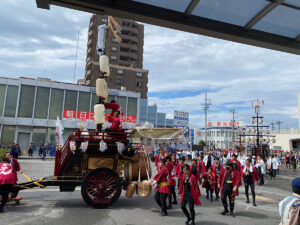
Ishitori Festival
【Tsushima City】 Date: The fourth Saturday and Sunday of May every year Tsushima Shrine's festivals were held using mikoshi (portable shrines), just like in neighboring areas, until 1935. In 1935, the Ishitori Festival began with the purchase of four festival floats from Kuwana. The Ishitori floats were originally used in the Edo period in Kuwana […]
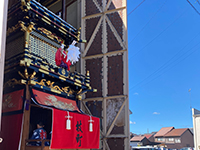
Inuyama Festival
【Inuyama City】 Date : First Saturday and Sunday of April every year The Inuyama Festival is a festival of Haritsuna Shrine, which enshrines the local guardian deity, and has been passed down to the present day since it began in 1635 (Kan'ei 12) with the encouragement of Naruse Hayatomasatora, lord of Inuyama Castle and a […]
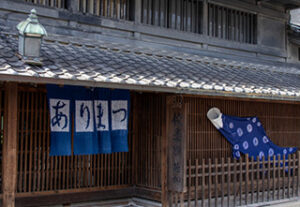
Arimatsu Shibori
Arimatsu shibori is a tie-dyed textile produced mainly in the Arimatsu and Narumi areas of Midori Ward, Nagoya. It is typically made by dyeing cotton fabric with indigo, and the pattern changes depending on how the thread is tied. It is a traditional craft of the Arimatsu and Narumi areas of Nagoya, and almost all […]

Iaido
Why not have a real samurai experience on a traditional Noh stage? Iaido is a martial art in which you practice the series of movements required to sheathe a Japanese sword, from drawing it to defeating an imaginary enemy. Unlike kendo, you do not actually fight an opponent, but practice forms against an imaginary enemy, […]
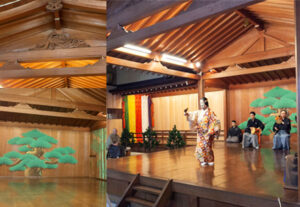
Kashokaku Nohgaku
Nohgaku is a traditional performing art that represents Japan, and is a collective term for Noh and Kyogen. It was perfected by Kannami and Zeami during the Muromachi period, and has a history of over 600 years. Noh is a musical and dance drama based on song and dance, performed while wearing Noh masks. Nohgaku […]
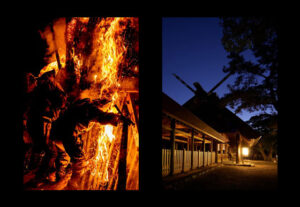
Toba Fire Festival: A Unique Festival of the World「Reservations Now Being Accepted」
The Toba Fire Festival, which began approximately 1,200 years ago, is held on January 7th of the lunar calendar, now the second Sunday of February, at Toba Shinmeisha Shrine in Toba Town, Nishio City, Aichi Prefecture. A large, 7-meter-tall torch made of bamboo and thatch called "suzumi" is lit. The Miyanishi River divides the area […]
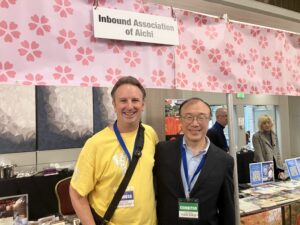
November 14, 2025 Exhibited at Japanese Food Expo 2025 in Los Angeles
At the Japanese Food Expo 2025, held at the Hilton Universal City Hotel, we exhibited to promote our tours and gave a presentation at the Japan Travel Seminar. The exhibition, held in the hotel's banquet hall, featured 100 exhibitors, primarily food manufacturers and distributors, and attracted 204 buyers and 2,600 general consumers. The Inbound […]
7-hour tour of Iaido martial arts and Japanese swords「Now accepting reservations」
Why not have a real samurai experience on a traditional Noh stage? Iaido is a martial art in which you practice the series of movements required to sheathe a Japanese sword, from drawing it to defeating an imaginary enemy. Unlike kendo, you do not actually fight an opponent, but practice forms against an imaginary enemy, […]
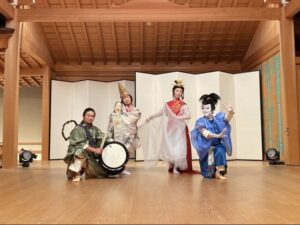
Nishikawa Style Japanese Dance Experience 「Now accepting reservations」
Founding of the Nishikawa School The Nagoya-based Nishikawa School was founded by Nishikawa Koisaburo I in 1841. Koisaburo boldly incorporated the strengths of Noh and Kyogen into his own dance, creating a unique style that sets him apart from traditional Kabuki dance. This style is still alive in Nagoya today as the Nishikawa School of […]

David Atkinson revisits "New Tourism Nation Theory" on September 24, 2025
Presenter: David Atkinson, President and CEO, Konishi Art and Craft Co., Ltd.
In his 2015 book "The New Tourism Nation Theory," he argued that Japan, facing a rapid population decline, could become prosperous through the tourism industry, using numerical analysis befitting a former analyst.
Ten years later, just as he predicted, inbound tourism has increased, and annual revenues are approaching 10 trillion yen, making it the second-largest industry after automobiles. Atkinson says this is not a prediction, but the result of his continuous lobbying of the government to make it happen.